For a Sulzer 6RTA68 or any large two-stroke marine diesel engine, a cylinder liner that wears excessively within 3 months after renewal usually indicates an underlying operating or maintenance problem rather than a poor-quality liner itself. Though Matral can be partly the cause.
Common causes include:
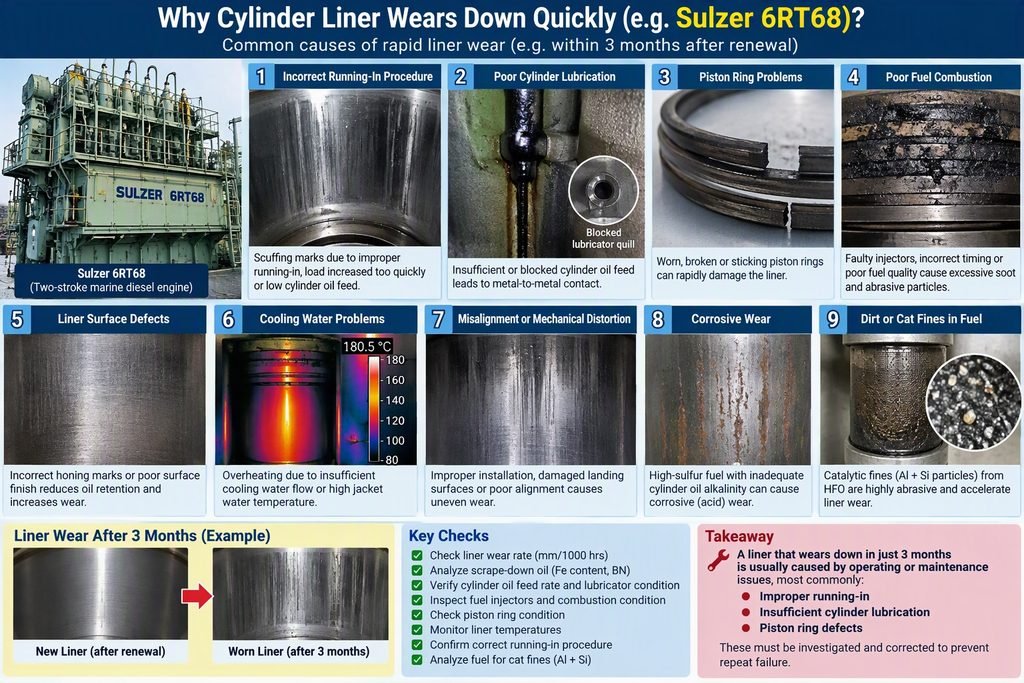
1. Incorrect Running-In Procedure (Most Common)
A new liner and piston rings need a proper running-in period.
If:
- Engine load is increased too quickly,
- Cylinder oil feed is reduced too early,
- Running-in oil is not used as recommended,
then the rings cannot bed properly against the liner, causing scuffing and abnormal wear.
2. Poor Cylinder Lubrication
Insufficient or ineffective cylinder oil causes metal-to-metal contact.
Possible reasons:
- Low cylinder oil feed rate.
- Blocked lubricator quills.
- Incorrect BN (Base Number) cylinder oil selection.
- Faulty lubricator timing.
Signs:
- Polishing of liner surface.
- Scuff marks.
- Increased iron content in scrape-down oil analysis.
3. Piston Ring Problems
Even with a new liner, worn or damaged rings can rapidly destroy the liner.
Examples:
- Broken ring.
- Ring sticking in grooves due to deposits.
- Incorrect ring clearances.
- Wrong ring material.
4. Poor Fuel Combustion
Bad combustion creates excessive soot and abrasive particles.
Causes:
- Faulty fuel injectors.
- Incorrect injection timing.
- Poor fuel quality.
- Low compression pressure.
This leads to abrasive wear on both rings and liner.
5. Cylinder Liner Surface Defects
If honing marks are incorrect or the liner surface finish is outside specifications:
- Oil retention becomes poor.
- Lubricating film breaks down.
- Wear rate increases dramatically.
6. Cooling Water Problems
Overheating changes liner temperature and lubrication conditions.
Check:
- Jacket cooling water temperature.
- Cooling water flow.
- Liner wall temperatures.
Overheated liners can suffer scuffing wear.
7. Misalignment or Mechanical Distortion
If:
- The liner was not fitted correctly,
- Landing surfaces were damaged,
- Piston rod alignment is poor,
the piston may not move centrally, causing uneven wear patterns.
8. Corrosive Wear
Using high-sulfur fuel with inadequate cylinder oil alkalinity can cause acid attack.
Indicators:
- Rust-like appearance.
- High iron content.
- Rapid diameter increase.
9. Dirt or Cat Fines in Fuel
Catalytic fines (Al+Si particles) from heavy fuel oil are extremely abrasive.
If fuel treatment is poor:
- Purifiers ineffective.
- Filters bypassed.
Then liners and rings can wear out very quickly.
What You Should Check First
For a liner worn out in only 3 months, investigate:
- Wear rate records (mm/1000 hrs).
- Scrape-down oil analysis (Fe, BN).
- Cylinder oil feed rate.
- Fuel injector condition.
- Piston ring condition.
- Liner temperature records.
- Running-in procedure after renewal.
- Fuel analysis for cat fines (Al+Si).
In practice on Sulzer RT-flex and RTA engines, the most frequent reasons for very rapid wear after liner renewal are improper running-in, insufficient cylinder lubrication, or piston ring defects. These can destroy a new liner within a few hundred operating hours if not detected early.